Jan. 12, 2026 – For students like Tayshawn Covington, visiting the district’s new 3D Printing Lab was more than just a field trip—it was an opportunity to learn and grow.
“I always like to try something new, because you never know what’s out there,” said the fifth grader. “You never know in life where you can find opportunity.”
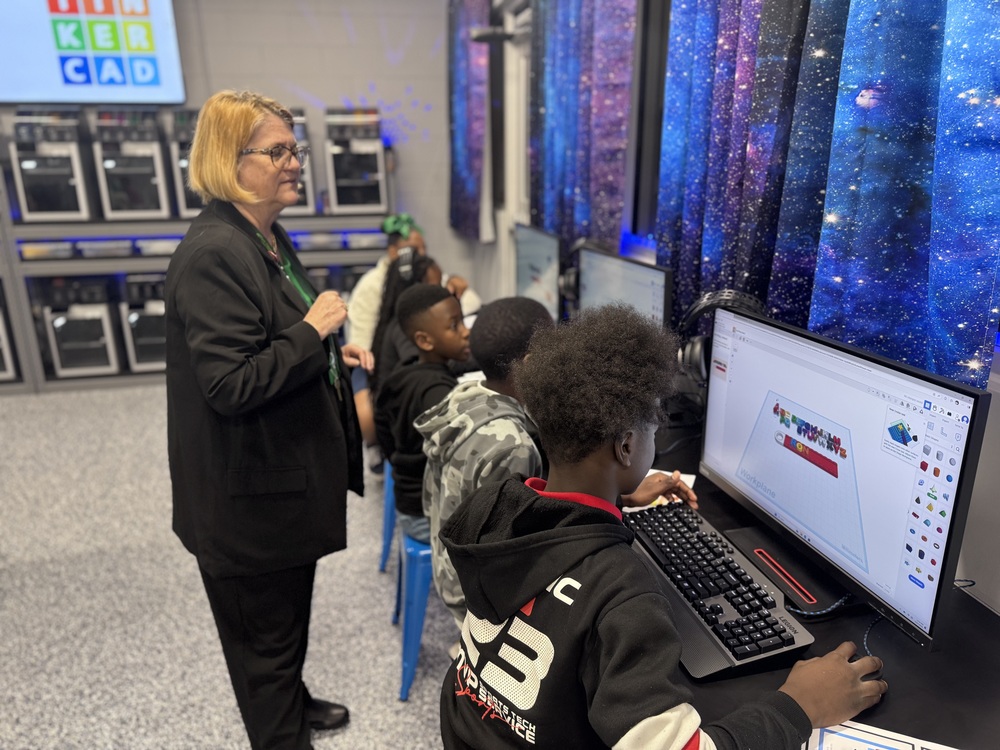
Covington was among the first group of students invited to visit the lab and field trip center as it opened its doors for the first time. Fifty Fort Caroline Elementary School students had the chance to “test drive” the new facility, which includes 16 new 3D printers, 20 computer workstations, and countless possibilities.
“Technology continues to grow and grow,” said Dr. Yvonne Day, director of K-12 science. “So if we can help our students go from consumers of technology to innovators and creators by learning about this technology at such a young age, we can really prepare them for the future.”
Known as the STEM Forge, the 3D Printing Lab is housed within the DCPS STEM Innovation Center at A. Philip Randolph Career Academies. Educators call the lab a step forward in preparing students for career-ready skills, such as the engineering design process and prototyping.
Fifth-grade student Dayriel Ortiz could already see how the lab would test his knowledge of math and science.
“You get to learn shapes and how they work together,” he explained. “You have to use the computer to make 3D shapes and models.”
Beyond strengthening students’ academic skills, educators hope the lab awakens new levels of excitement and curiosity for STEM subjects.
“They are definitely taking ownership, talking with each other, and collaborating,” said Fort Caroline Elementary School Principal Dr. Faith Roberts-Graham. “It also sparks critical thinking that you sometimes don’t get in a traditional classroom setting.”
The new addition was made possible by federal funding through the DoDEA, or Department of Defense Education Activity, and local partners including JEA, Chhem Coatings, and Arete Construction. Currently, it is open to fourth- and fifth-grade students, with plans to expand to additional grade levels.
“Once they see what the technology can do, our kids can think of really creative solutions to common problems—and that’s really what we want them to do,” said Dr. Day. “If they can be constructivists and find solutions rather than just giving up, then we’re giving them skills for life.”